
CASA CURUTCHET


The installation of textured concrete floor tiles, combined with a continuous mirror extending from wall to ceiling, heightens bodily awareness within the space. These interventions amplify the perception of movement and spatial positioning, activating a heightened sense of kinesthesia. The body becomes both observer and instrument, consciously negotiating its relationship to surface, reflection, and materiality.
Interior design // Interventions
Design and fabrication of a handmade textured concrete tile.


The brushed stainless steel stairs highlight the sense of touch. Their cool surface underfoot increases bodily awareness, making each step more conscious. Through temperature and texture, the material directly engages the body, strengthening the experience of movement within the space.


The brushed stainless steel toilet and sink extend the materiality of the stairs, creating a coherent sense of continuity. Their cool, smooth surface stimulates the sense of touch, activates kinesthetic awareness, and heightens bodily consciousness within the intimate space.


The doors, covered in locally sourced Argentine leather, subtly transform the acoustics of the room by absorbing some of the reverberation and outside noise. As Argentina is one of the world’s leading leather producers, this material choice affirms a strong territorial connection. The warmth of the material adds sensory depth while integrating a meaningful local cultural dimension into the interior design.


Outside, the installation of terracotta tiles, used throughout the house and extended into the courtyard, ensures material continuity between interior and exterior. Their slightly rough texture and warmth underfoot activate the sense of touch and kinesthetic awareness, making movement more conscious.
Beyond its strong cultural presence in local architecture, terracotta intensifies the sensory experience of the space by creating a direct connection between the body, the ground, and the territory.
The application of black concrete throughout the space intentionally compresses the perception of the room. Its dark tone absorbs light and emphasizes boundaries, creating an almost intimate sense of enclosure.
This spatial contraction prepares the transition toward the open-air courtyard, shifting from a dense, contained interior to a bright and expansive exterior. The body then experiences a heightened, almost dramatic sense of openness and scale.


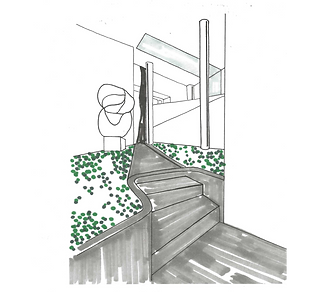

On the floor, the integration of a carpet of Dichondra repens a resilient groundcover plant adapted to temperate climates such as Argentina’s softens the surrounding materiality and reinforces the interior–exterior relationship already present within the building.
Flexible underfoot and able to withstand light foot traffic without damage, it activates the sense of touch through its delicate texture. Its subtle scent is released upon contact, gently stimulating the sense of smell.
This living presence intensifies kinesthetic awareness, making each movement more conscious and deeply rooted in the sensory experience of the space.
The goal of this research was to reflect, beyond the visual, on the complex nature of architecture and interior design. This project explores the role of the senses in the perception of the environment, as well as the experience and orientation of body and space. The aim was to propose a new sensory experience through the multisensory dimensions offered by the discovery of this iconic house, Casa Curutchet by Le Corbusier.
This project was completed at the Université de Montréal, in collaboration with Juliette Colmort, as part of the course DEI1019 - Atelier 2